
The Hidden Cost of Time: How Duration Risk Destroys Returns in Litigation Finance
In the sophisticated world of litigation finance, investors often focus on case merit, legal team quality, and potential award amounts. However, one critical factor frequently receives insufficient attention despite its profound impact on investment performance: duration risk. This temporal hazard—the risk that a case takes significantly longer to resolve than anticipated—can systematically erode returns even when legal outcomes prove favorable, creating a silent destroyer of ROI.
Understanding Duration Risk in Litigation Finance
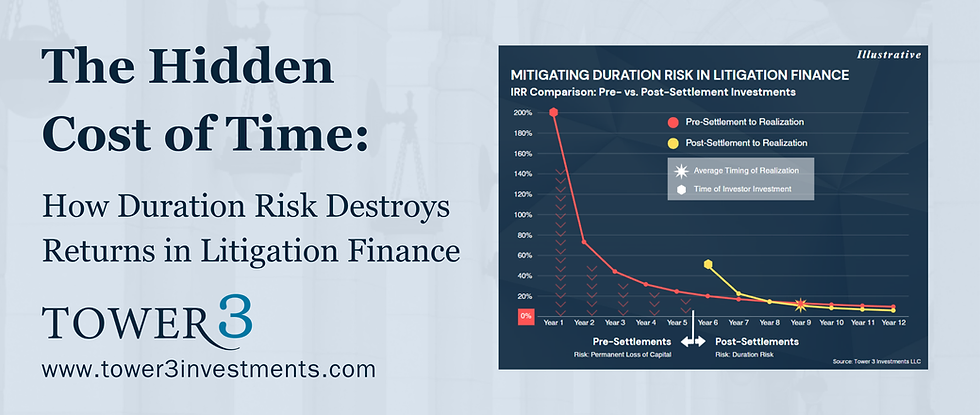
Duration risk represents the fundamental uncertainty surrounding case resolution timelines in litigation finance investments. Unlike traditional financial instruments, where payment schedules are often contractually defined, litigation investments operate within an inherently unpredictable judicial system where delays can extend cases by months or years beyond initial projections. While to a limited extent, duration risk also exists in post-settlement/judgment transactions, it is more limited and predictable.
The mathematics of duration risk is unforgiving. When a case is expected to resolve in 18 months and instead takes 36 months, the internal rate of return (IRR) suffers dramatically, even if the ultimate recovery amount meets or exceeds expectations. This temporal drag compounds over time, transforming what appeared to be an attractive investment opportunity into a mediocre performer that fails to justify its risk-adjusted return target.
Consider a hypothetical $1 million investment expected to return $2 million within 18 months, generating an impressive 59% IRR. If that same case extends to 36 months due to court delays, discovery disputes, or appeal processes, the IRR plummets to approximately 26%—a reduction of more than half despite achieving the identical financial outcome.
The Compounding Effect of Prolonged Litigation Timelines
Duration risk operates as a silent tax on litigation finance returns, creating opportunity costs that extend far beyond the immediate investment. Extended case durations tie up capital that could otherwise be deployed in new opportunities, reducing return of capital to investors, portfolio turnover and limiting the compounding effects of successful investments.
The judicial system's inherent unpredictability exacerbates this challenge. Court calendar congestion, judge availability, discovery disputes, and procedural motions can extend cases well beyond reasonable expectations. Economic factors, such as defendant financial distress or strategic delay tactics, introduce additional temporal uncertainties that sophisticated investors must acknowledge and plan for in their investment frameworks.
Furthermore, prolonged cases often require additional capital injections to cover mounting legal expenses, creating a double impact on investor returns. These follow-on investments, while sometimes necessary to protect the initial investment, dilute overall returns and increase total capital at risk.

Pre-Settlement/Judgment vs. Post-Settlement/Judgment: A Strategic Duration Analysis
The litigation finance landscape offers investors two distinct approaches with markedly different duration risk profiles: pre-settlement/judgment and post-settlement/judgment investments.
Pre-Settlement/Judgment Financing: High Risk, High Reward
Pre-settlement/judgment financing involves funding active litigation where legal outcomes remain uncertain. While these investments offer equity-like return potential—sometimes generating multiples of invested capital—they present significant exposure to both extended timelines and total loss of investment. Duration risk in pre-settlement/judgment investments compounds with legal risk, creating a complex risk matrix that can significantly impact portfolio performance.
Pre-settlement/judgment cases face numerous temporal challenges: discovery phases that extend beyond expectations, motion practice that delays trial dates, settlement negotiations that stall due to disagreements, and appeal processes that add years to resolution timelines. Each of these factors independently and collectively contributes to duration risk that can materially impact investor returns.
Post-Settlement/Judgment Investments: Credit-Like Returns with Reduced Duration
Post-settlement/judgment investments present a fundamentally different risk-return profile. These opportunities arise after legal disputes have been tentatively settled or a judgment entered. While these cases are still subject to court approval and possible appeals, they afford investors a more predictable and shortened duration than investing pre-litigation or pre-settlement/judgment.
The duration advantage in post-settlement/judgment investments stems from several factors: liability, a primary risk factor in all litigations, has already been determined. This allows resolution timelines to be more predictable due to mostly administrative rather than adversarial processes. Capital requirements are also generally lower due to the advanced status of the case which makes the need for recapitalization due to unforeseen or unaccounted for delays less likely. The concern of “throwing good money after bad” is a real concern is pre-settlement/judgment litigation finance.
Tower 3's Strategic Focus: Capitalizing on Post-Settlement/Judgment Timing Inefficiencies
At Tower 3 Investments, we have identified a specific market inefficiency within the post-settlement/judgment space that offers attractive risk-adjusted returns while mitigating duration risk. Our investment strategy targets situations where legal disputes have been resolved but liquidity remains constrained due to the time lag between settlement/judgment to actual payout.
Target Investment Scenarios
Our investment focus concentrates on post-settlement/judgment situations involving:
Court Approvals in Class Action Matters: Large-scale multi-party settlements/judgments often require judicial approval processes and interim appeals by objectors that can sometimes take as long as two years, if not a little longer, creating liquidity gaps for plaintiffs, their counsel and other court appointed service providers that are dependent on the timeliness of settlement/judgment payments.
Complex Distribution and Administrative Processes: Class Actions often involve a large number of plaintiffs, and settlement grids that require plaintiffs to be qualified before they are permitted to participate in a settlement. Complicated administration and distribution processes can often take as long as 1-2 years.
Structured Settlement Terms: Some settlement agreements include payment schedules that extend the payments beyond a single bullet payment, creating opportunities for present-value financing solutions.
Systematic Duration Risk Mitigation Strategies
Effective duration risk management requires systematic approaches that acknowledge temporal uncertainty while implementing strategies to minimize exposure and optimize returns.
Conservative Timeline Underwriting
Our underwriting process incorporates conservative timeline assumptions based on historical data and realistic assessment of procedural and administrative requirements. Rather than optimizing for best-case scenarios, we model expected durations using median resolution times and build appropriate risk premiums into our return requirements.
Selective Case Criteria
We focus on settlements requiring court approval or judgments, which typically offer more predictable timelines. Fortune 1000 type defendants, which are generally the targets of such litigation, generally have stronger incentives to complete settlement processes efficiently and put the settlement in their rear-view mirror.
Disciplined Capital Structure
Our investment structures avoid over-advancing, ensuring that our total exposure remains appropriate relative to expected recovery amounts and timelines. This disciplined approach protects against the dual risks of duration extension and potential recovery shortfalls.
Information Advantage in Down-Market Opportunities
We actively target less institutional-focused opportunities and strive to avoid crowded trades where competition may compress returns while accessing deals with superior risk-adjusted characteristics. There is simply no point in over advancing or under charging for the risks being taken.

The Strategic Value of Duration-Focused Investing
Duration risk management in litigation finance extends beyond simple timeline prediction. Sophisticated investors recognize that systematic duration risk mitigation can create sustainable competitive advantages through improved capital efficiency, enhanced portfolio turnover, and more predictable cash flow generation.
By concentrating on post-settlement/judgment investments with historically shorter durations, investors can achieve several strategic objectives: reduce overall portfolio volatility through more predictable resolution timelines, increase capital deployment velocity through faster investment cycles, improve risk-adjusted returns by minimizing temporal drag on performance, and create more institutional-quality investment profiles that appeal to sophisticated investors.
Conclusion: Duration as a Differentiating Investment Factor
In litigation finance, duration risk represents both a significant challenge and a potential source of competitive advantage. While eliminating temporal uncertainty entirely is impossible within the judicial system, strategic investors can systematically manage duration exposure through careful opportunity selection, conservative underwriting, and disciplined investment structures.
Tower 3 Investments' focus on post-settlement/judgment opportunities reflects our conviction that duration risk mitigation, combined with our 30+ years of litigation finance experience, creates superior risk-adjusted investment opportunities. By targeting the post-settlement/judgment timing delta—the period between legal resolution and liquidity availability—we deliver consistent returns while avoiding the binary risks and extended timelines associated with active litigation.
For institutional investors seeking uncorrelated alternative investments with manageable risk profiles, post-settlement/judgment litigation finance offers a compelling opportunity to capture attractive returns while mitigating the duration risks that can destroy value in traditional litigation finance strategies. The key lies in recognizing that in litigation finance, time truly is money — and managing that temporal risk can mean the difference between exceptional and mediocre investment performance.
Roni Dersovitz is the founder of Tower 3 Investments, LLC a firm offering investment opportunities in Post-Settlement/Judgment Litigation Funding. Mr. Dersovitz has 14 years of experience as a practicing personal injury attorney and has managed portfolios of Receivables since 1998. To learn more about access to differentiated returns through litigation finance, visit www.Tower3Investments.com or contact us at info@Tower3Investments.com.


